Precision as Poetry: How America's Most Analytical Chefs Are Applying Mathematical Principles to the Architecture of Taste
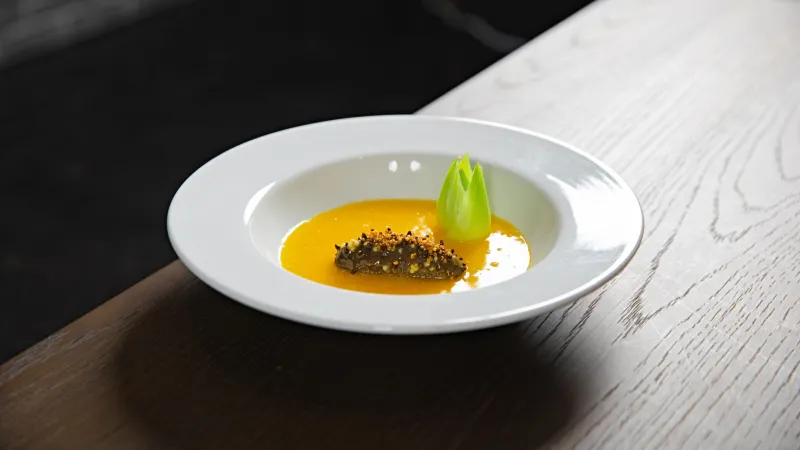
There is a particular kind of silence that descends over a certain class of American kitchen—not the silence of inactivity, but the concentrated quiet of calculation. In these spaces, the chef does not merely taste and adjust; he measures, models, and derives. A sauce is not corrected by instinct alone but interrogated through the lens of acid-to-fat ratios. A plated composition is not arranged by eye but plotted along invisible axes of proportion and symmetry. The kitchen, in these establishments, has become something approaching a geometry class conducted in the language of flavor.
This is not the province of molecular gastronomy's theatrical excess, the era of edible foams and liquid nitrogen spectacle that defined the early aughts. What is emerging in America's most intellectually rigorous kitchens is quieter and, in many respects, more demanding: a systematic effort to understand taste itself as a quantifiable phenomenon, one subject to the same principles of ratio, recursion, and proportion that govern architecture, music, and mathematics.
The Recipe as Equation
At its most fundamental level, cooking has always been mathematical. The baker's percentage, the ratio of salt to water in a brine, the balance of sugar to acid in a reduction—these are expressions of proportion, however informally applied. What distinguishes the current movement is the deliberateness with which certain chefs are extending this logic across every dimension of a dish.
Consider the approach taken in kitchens where head chefs maintain what might be called flavor matrices: spreadsheets and diagrams that map the molecular weight of aromatic compounds against their volatility thresholds, allowing them to sequence a dish's aromatic progression the way a composer sequences a chord resolution. The idea is that flavor is not a single event but a temporal architecture, and that architecture can be designed with precision.
Some practitioners draw explicitly on the golden ratio—approximately 1.618 to 1—a proportion observed in natural forms from nautilus shells to sunflower seed arrangements, and long employed by architects and painters to achieve compositions that the eye finds instinctively satisfying. Applied to plating, this ratio governs the relationship between a primary element and its accompaniments, the negative space surrounding a protein, the curvature of a sauce pooled against a rim. The result is not a plate that announces its mathematical origins but one that registers, subconsciously, as correct.
Fractals and the Texture of Experience
Perhaps the most conceptually ambitious application of mathematical thinking in contemporary American haute cuisine involves the principle of self-similarity—the property, central to fractal geometry, by which a structure repeats its essential pattern at multiple scales. In nature, a coastline looks jagged whether observed from a satellite or a clifftop; a fern frond mirrors the shape of its individual leaflets.
Chefs who have absorbed this idea apply it to textural design. A dish might present crunch at three distinct scales: the audible shatter of a tuile, the granular resistance of a seasoned crumb, and the subtle grain of a carefully tempered emulsion—each a different magnitude of the same sensory principle. The diner does not consciously register the recursion, but the cumulative effect is one of unusual depth and coherence, a dish that seems to reward attention at every level of engagement.
Similar thinking informs the construction of flavor itself. When a single primary ingredient—say, aged Comté, or a late-season heirloom tomato—is expressed across multiple preparations within a single course, each iteration revealing a different facet of the same compound profile, the result is a kind of harmonic resonance. The flavor is not simply repeated; it is refracted, the way a prism reveals the spectrum latent within white light.
Molecular Weight and the Sequencing of Sensation
The intersection of chemistry and gastronomy is not new, but the sophistication with which American chefs are now engaging with molecular science has reached a level that warrants serious attention. An understanding of molecular weight and volatility has become, in certain kitchens, as essential as knife technique.
Aromatic compounds with lower molecular weights tend to volatilize quickly—they announce themselves immediately upon a dish's arrival, creating the crucial first impression. Heavier compounds linger, releasing gradually over the course of a bite or even persisting on the palate into the next course. Chefs who understand this architecture can construct a dish that unfolds in deliberate sequence: the bright, fleeting grace note of a citrus zest giving way to the slower, more resonant warmth of a toasted spice, which in turn yields to the deep, almost subterranean persistence of a fermented element.
This is flavor not as a simultaneous chord but as a melody—and its composition requires the same kind of temporal precision that a musician brings to phrasing.
The Ethics of Calculation
Not everyone in the American culinary world regards this mathematical turn with unqualified admiration. There are chefs of considerable distinction who argue that the reduction of taste to quantifiable variables risks something irretrievable—the element of surprise, of human imprecision, of the kind of intuitive leap that produces a genuinely original dish. The greatest cooking, in this view, cannot be derived; it must be felt.
This is not an argument to be dismissed. The history of gastronomy is populated by moments of productive accident, by the saucier who over-reduced and discovered a new depth of flavor, by the pastry chef whose mis-measured leavening produced a texture never before achieved. Calculation, pursued too rigidly, may close off the very corridors through which innovation enters.
Yet the most thoughtful practitioners of mathematical gastronomy would resist the characterization of their work as mechanical. For them, the numbers are not a substitute for intuition but a refinement of it—a means of understanding, after the fact, why a particular combination works, and of reproducing that understanding with sufficient reliability to build upon it. The equation does not replace the poet; it gives the poet a more precise vocabulary.
Toward a New Literacy of the Table
What the mathematical kitchen ultimately offers the American dining public is a new kind of legibility. A diner who understands that the progression of flavors in a tasting menu has been as deliberately sequenced as a symphony, that the proportions of a composed plate reflect principles operative in the natural world, that the textures layered within a single bite have been calibrated to engage the palate across multiple registers—that diner is not merely eating. He is reading.
Apicius, the legendary Roman gastronome whose name this publication bears, was himself a man of systematic appetite, a collector and codifier of culinary knowledge at a moment when such systematization was itself a form of cultural ambition. The chefs now bringing mathematical rigor to the American table are engaged in a not entirely dissimilar project: the elevation of appetite into understanding, of pleasure into knowledge.
In their kitchens, the most ancient of human activities—the preparation and sharing of food—has acquired a new dimension of intellectual seriousness. And the table, set with such deliberate precision, becomes something more than a place to eat. It becomes a place to think.


