The Architecture of Absence: Why America's Most Disciplined Chefs Are Building Flavor Around What Isn't There
There is a moment, familiar to anyone who has attended a great concert, when the orchestra falls silent. Not because the music has ended, but because the composer has demanded stillness—a breath, a caesura, a deliberate suspension that makes the returning note land with almost unbearable force. The finest American chefs working today have begun to understand that the palate operates by precisely the same logic.
They are not minimalists in the casual sense of that overused word. They are architects of absence: practitioners who design flavor not merely by selecting what to include, but by engineering with equal precision what to withhold. The void, in their kitchens, is not an oversight. It is a load-bearing element.
The Neuroscience Beneath the Philosophy
To appreciate why deliberate flavor gaps function as they do, one must first reckon with how the brain processes taste. Sensory adaptation—the well-documented phenomenon by which repeated stimulation dulls perception—operates as aggressively on the palate as it does on any other system. Present a diner with an unbroken sequence of richness, acidity, or spice, and the nervous system begins to normalize the signal. The flavors do not diminish in the dish; they diminish in the mind.
Contrast, however, resets the system. A moment of palatal neutrality—a bite of something deliberately unassertive, a sip of still water elevated to structural purpose, an interlude of pure texture without pronounced taste—functions neurologically as a kind of recalibration. What follows is perceived not merely as different, but as heightened, clarified, newly vivid. The brain, deprived briefly of stimulation, greets the returning flavor with renewed acuity.
Several chefs working at the apex of American fine dining have begun to apply this understanding not intuitively, as generations of great cooks have done before them, but with the deliberateness of a composer annotating a score.
Silence as Syntax
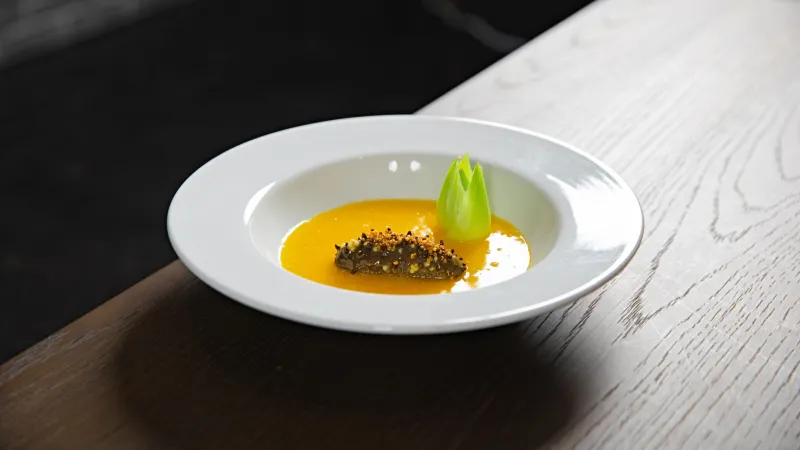
At one celebrated New York tasting room, the kitchen structures its progression around what the chef describes as "flavor rests"—courses or components designed to offer the palate a moment of genuine quietude before the next movement of the meal. A delicate consommé, clarified to near invisibility and seasoned with the restraint of a whisper, arrives not as a course of substance but as a reset. It clears not the table but the mind.
"We think about the meal as a sentence," this chef has explained to guests willing to engage with the philosophy behind the sequence. "Every sentence needs punctuation. Without it, meaning collapses into noise."
The analogy to language is not accidental. Linguists have long observed that meaning in spoken and written communication is shaped as much by pause, silence, and the strategic withholding of information as by the words themselves. The same grammar, these chefs argue, governs the experience of eating at its most considered.
The Discipline of the Uncommitted Bite
In practice, engineering negative flavor space demands a counterintuitive form of discipline. The instinct of a trained chef—one educated in the classical French tradition or in the bold idiom of contemporary American cooking—is to build, to layer, to intensify. Every component must justify its presence. Every element must contribute.
The new philosophy inverts this imperative. The uncommitted bite, the component that offers texture without insistence, the broth that nourishes without demanding attention: these require as much craft to execute as the dish that announces itself boldly. Perhaps more. It is straightforward to make something taste of something. To make something taste of almost nothing, while remaining pleasurable and purposeful, is a discipline of the highest order.
A chef at a prominent San Francisco restaurant that has earned considerable critical attention in recent years describes the challenge with characteristic precision: "The hardest thing I have ever cooked is something that doesn't get in the way. You have to remove every element that asserts itself, every note that pulls focus, and leave behind something that is present without being loud. Most kitchens have never tried to do that. Most kitchens are afraid of quiet."
The Philosophical Lineage
The intellectual roots of this approach extend well beyond the contemporary kitchen. The Roman gourmet Apicius, whose collected writings represent the oldest substantial culinary record of the Western world, understood intuitively that the sequence of a meal shaped the experience of each individual dish. The ancient practice of serving palate-cleansing sorbets between courses was not mere convention; it was applied neuroscience, centuries before the discipline existed.
In the Eastern culinary traditions that have influenced so many American chefs of the current generation, the concept of ma—the Japanese aesthetic principle of negative space, of the meaningful interval—finds direct expression in the structure of kaiseki, the multi-course form that builds its emotional arc through alternation, restraint, and the strategic deployment of quietude. The finest American tasting menus now operating in cities from Chicago to Los Angeles betray this influence, whether their creators acknowledge it explicitly or not.
What the Diner Must Bring
There is an implicit demand placed upon the guest at tables where this philosophy governs the kitchen. Passive consumption—the posture of the diner who wishes merely to be pleased, to receive successive gratifications without engagement—will not unlock what these meals have to offer. The deliberate quiet of a flavor rest requires attention to be perceived as anything other than a lull.
This is, perhaps, the most aristocratic aspect of the approach. It assumes a diner educated enough, attentive enough, and curious enough to notice not only what is present but what is absent—and to understand that the absence is intentional, structural, meaningful. It asks the guest to listen for the rests in the music, not merely to wait for the next note.
For those willing to bring that quality of attention to the table, the reward is considerable. A meal constructed around deliberate flavor voids does not simply taste good. It teaches the palate to hear itself—to perceive, with a clarity that ordinary dining rarely affords, the full dimension of what a thoughtful kitchen is capable of saying.
Toward a New Standard
As American fine dining continues its evolution toward greater intellectual sophistication, the architecture of absence is likely to become an increasingly recognized criterion of culinary mastery. The ability to dazzle with intensity has always been within reach of the technically gifted. The ability to move through restraint—to trust the void, to believe in silence, to build meaning around what is not there—belongs to a rarer category of practitioner.
These are the chefs who understand, in the fullest sense, what it means to compose a meal rather than simply to cook one. Their tables are not merely restaurants. They are, at their finest, arguments about the nature of perception itself.