The Eloquence of Absence: How America's Most Visionary Chefs Are Mastering the Art of the Empty Plate
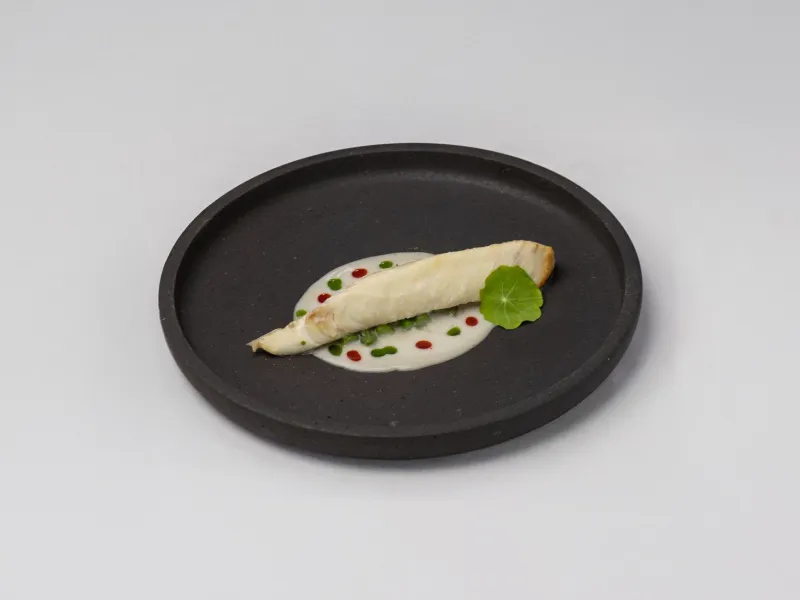
There is a particular kind of confidence required to leave a plate largely bare. In an industry long seduced by abundance—by the towering architectural constructions, the sauces pooled in elaborate calligraphy, the garnishes multiplied until they crowd every centimeter of porcelain—the decision to surrender space is not merely aesthetic. It is, for a growing number of America's most accomplished chefs, a declaration of philosophy.
Negative space, the term borrowed from the visual arts to describe the deliberate voids surrounding a composition's subject, has migrated from the galleries of SoHo and the design studios of Los Angeles into the kitchens of the nation's most distinguished restaurants. The result is a new vocabulary of plating—one in which silence speaks as eloquently as substance, and where the eye is guided not by crowding but by careful orchestration of emptiness.
The Canvas Before the Brushstroke
To understand this movement, one must first appreciate what fine dining plating has historically asked of its practitioners. For much of the twentieth century, the European brigade tradition rewarded generosity of presentation. A plate well-composed was a plate well-filled. The nouvelle cuisine revolution of the 1970s began to challenge this orthodoxy, introducing smaller portions and more deliberate arrangements, but even those compositions often relied on density of element rather than true spatial economy.
What distinguishes the current American vanguard is the conscious embrace of the void as a primary compositional tool—not an afterthought, but the foundation from which every other decision flows. Chefs operating at this level will often determine the negative space first, then construct the dish around it, much as an architect designs the air within a building before considering the walls.
At Quince in San Francisco, chef Michael Tusk has long employed a spare, meditative plating language that invites the diner's gaze to settle and linger rather than race across a crowded surface. A single hand-rolled pasta pillow, dressed with the most restrained application of aged butter and truffle, occupies perhaps a quarter of its wide, matte-white vessel. The surrounding expanse is not emptiness—it is anticipation made visible, a frame that elevates the subject within it to near-sacred status.
The Japanese Inheritance
It would be intellectually dishonest to discuss negative space in American fine dining without acknowledging its most profound philosophical antecedent: the Japanese aesthetic concept of ma, roughly translated as the meaningful interval or pause between elements. In Japanese art, architecture, music, and cuisine, ma is not the absence of something but the presence of potential—a charged emptiness that gives surrounding forms their resonance and weight.
This sensibility has permeated American culinary thinking in ways both direct and oblique. The kaiseki tradition, with its exquisitely considered placement of a single slice of fish against the rough texture of a handmade ceramic, has served as a template for American chefs who encountered it through travel, study, or the influential writings of figures like Shizuo Tsuji. The lesson absorbed was not merely visual but deeply philosophical: that generosity in dining can be expressed through focus rather than volume, and that what is withheld can honor an ingredient more profoundly than what is added.
Chef Corey Lee of Benu in San Francisco—whose kitchen synthesizes Korean heritage with French technique and Japanese spatial sensibility—describes his plating process as one of progressive elimination. "The first draft of a dish is always too much," he has noted in various interviews. "The work is in the removal. You take away until the dish tells you it is finished, and often that moment arrives far sooner than you expect."
Modernist Design and the Architecture of Appetite
Beyond Eastern aesthetics, the influence of twentieth-century Western modernism—Bauhaus functionalism, the spare geometries of Donald Judd's minimalist sculpture, the graphic economy of Swiss International Style typography—has filtered into the consciousness of a generation of chefs educated as much in design as in classical cookery.
The parallels are not merely decorative. Modernist design's central conviction—that the elimination of the superfluous reveals the essential—maps with striking precision onto the culinary philosophy of restraint. A plate conceived under these principles asks a fundamental question of every element proposed for inclusion: does this earn its presence? Does it contribute meaning, texture, flavor, or visual logic that would be lost without it? If the answer is equivocal, the element is removed.
At Atomix in New York City, chefs Junghyun and Ellia Park construct presentations of such deliberate economy that each dish arrives with the visual authority of a completed sentence rather than a paragraph. Components are placed with what appears to be mathematical precision—and in many cases, actually is, with measurements employed during development to ensure that spatial relationships remain consistent across service. The effect is not cold or clinical but intensely focused, directing the diner's attention with a kind of gentle authority.
The Psychological Dimension
The case for negative space extends beyond aesthetics into the psychology of perception and appetite. Cognitive research into visual attention suggests that the eye, when confronted with a densely populated field, distributes its focus broadly and somewhat indiscriminately. Presented with a spare composition, however, the gaze is drawn irresistibly to the subject, and the act of looking becomes more deliberate, more intimate.
This heightened visual attention has measurable consequences for the dining experience. When a guest truly sees what is before them—when a single langoustine tail, precisely torched and resting on a brushstroke of fermented cream, commands the full architecture of a twelve-inch plate—the anticipation preceding the first bite is qualitatively different from that generated by a more crowded presentation. The diner has been made to notice, to consider, to desire. The empty space has done its work.
Chef Grant Achatz of Alinea in Chicago, whose career has been defined by the interrogation of dining convention, has spoken of negative space not merely as a visual strategy but as a temporal one. The pause that emptiness creates—the moment of contemplation before the fork descends—is, in his view, as much a part of the dish's flavor as any ingredient. The eye, he suggests, primes the palate.
Restraint as a Form of Respect
Perhaps the most compelling argument for the aesthetics of absence is the one that speaks directly to the philosophy of ingredient reverence that defines serious American cooking at this moment. To surround a single, exceptional component with generous space is to make an argument about its worth—to insist, without words, that this thing before you requires no embellishment, no distraction, no apology.
When a chef at a restaurant of the caliber of SingleThread in Healdsburg, California, places a fragment of barely-warmed Sonoma abalone on a vessel otherwise unoccupied, the message is unmistakable: this ingredient, sourced with precision and treated with the full measure of the kitchen's skill, is sufficient. The empty plate is not a failure of imagination but an expression of confidence—in the ingredient, in the technique, and in the diner's capacity to receive them both without mediation.
This is, ultimately, what distinguishes the philosophy of negative space from mere minimalism as trend. It is not about doing less because less is fashionable. It is about understanding that the plate is a stage, that attention is finite, and that the most generous act a chef can perform is to direct that attention, with absolute clarity, toward what matters most. In the most refined American dining rooms of this era, the empty space around a dish is not nothing. It is, in every meaningful sense, the frame that makes the painting possible.