From Offal to Opulence: The Refined Art of Whole-Ingredient Cuisine at America's Most Ambitious Tables

Photo: Sebastiaen Vrancx, Public domain, via Wikimedia Commons
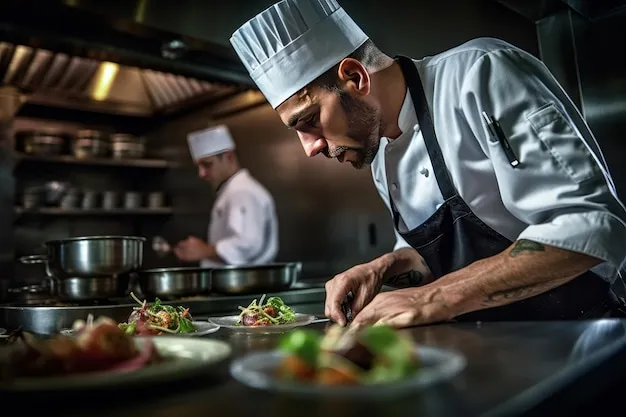
There is a particular kind of culinary confidence required to place a braised lamb's tongue at the center of a white-tablecloth tasting menu and present it not as a curiosity or a provocation, but as the natural, inevitable expression of a kitchen's philosophy. It is the confidence of a chef who has studied the ingredient with the same devotion once reserved for a prime rack or a tenderloin — who understands its texture, its fat distribution, its response to heat, and its capacity, properly handled, to achieve something genuinely extraordinary on the plate.
This confidence is increasingly evident across America's finest dining rooms. What began as a corrective impulse — a reaction against the wastefulness of a culinary culture that prized only the most commercially convenient cuts — has evolved into something far more sophisticated. Whole-animal and root-to-stem cooking, once categorized as either rustic tradition or radical experimentation, has found a permanent and distinguished place in the vocabulary of American haute cuisine.
The Philosophical Underpinning
To understand why whole-ingredient cooking has ascended to the highest levels of American gastronomy, one must first appreciate the philosophical shift that preceded it. The movement is not, at its core, about economics or even environmental virtue, though both are genuine considerations. It is, more fundamentally, about a reorientation of culinary values — a rejection of the hierarchy that placed tenderloin above kidney, fillet above cheek, and leaf above stem, not on the basis of flavor or technique, but on the basis of convention and commercial convenience.
The chefs leading this reorientation argue, persuasively, that the most interesting cooking often happens at the margins — with the parts of an animal or plant that demand the greatest ingenuity to transform. A pork belly or a beef short rib offers richness and collagen; a head cheese or a trotter demands a more complex negotiation between the cook and the ingredient. The mastery required is greater, and so, these chefs contend, is the potential reward.
This is a distinctly Apician sensibility — one that honors the full complexity of the natural world rather than reducing it to a narrow range of approved commodities. The ancient Roman gastronome for whom the finest culinary pursuits are named understood that true connoisseurship demands engagement with the whole, not merely the convenient.
Forgotten Cuts, Rediscovered
Across the American culinary landscape, a quiet rehabilitation is underway. Cuts and preparations that disappeared from ambitious menus decades ago are returning — not in their original form, but transformed by contemporary technique and elevated by the context of serious, thoughtful kitchens.
Beef heart, properly trimmed and cured, possesses a clean, mineral intensity that no conventional steak can replicate. Slow-roasted and thinly sliced, it rewards the attentive palate with a depth that is both familiar and surprising. Pork jowl, rendered low and slow until its abundant fat becomes silken and yielding, achieves a richness that many chefs now prefer to the more celebrated belly. Lamb neck, braised for hours until its connective tissue dissolves into the cooking liquid, produces a braise of extraordinary complexity — gelatinous, deeply savory, and profoundly satisfying in a way that a rack presentation, however elegant, rarely achieves.
The vegetable kingdom offers equally compelling territory. Leek tops, broccoli stems, carrot greens, and corn cobs — ingredients that most professional kitchens have historically composted without a second thought — are being reconsidered as primary ingredients in their own right. Corn cob stock, slowly simmered, produces a broth of remarkable sweetness and body. Broccoli stems, properly peeled and treated, possess a delicate flavor and a satisfying firmness that the florets cannot match. Leek ash, produced by charring the dark green tops that are typically discarded, has become a refined finishing element in the hands of several prominent American chefs — its smoky bitterness a precise counterpoint to richer preparations.
The Technical Demands of Whole-Ingredient Cooking
It would be a mistake to characterize this movement as a simplification of culinary practice. Quite the contrary: working with the full range of an animal or plant demands a considerably broader technical repertoire than conventional fine dining preparation. The cook who works only with prime cuts operates within a relatively forgiving margin. The cook who works with offal, secondary cuts, and vegetable byproducts must master an entirely different set of transformations.
Curing, smoking, confiting, terrining, and the full range of charcuterie technique become essential rather than supplementary skills. Organ meats require precise temperature management and an understanding of their particular protein structures. Fermentation and preservation, increasingly central to root-to-stem kitchens, demand patience, scientific literacy, and a tolerance for productive unpredictability.
The result, when executed with genuine mastery, is a kitchen that operates at a higher level of integration than one organized around conventional hierarchy. Every element of an animal or plant has been considered, assigned a role, and prepared with intention. The tasting menu that emerges from such a kitchen tells a more complete story — one in which the connections between ingredients, between courses, and between the table and the land that produced the meal are rendered visible and meaningful.
Luxury and Conscience, Reconciled
For the American fine dining guest, the appeal of this approach operates on several levels simultaneously. There is the intellectual pleasure of encountering familiar ingredients in unfamiliar configurations — the recognition that one's assumptions about what belongs on a distinguished menu are being gently but firmly revised. There is the ethical satisfaction of dining at a table where waste is minimized and the full value of an animal's life or a season's harvest is honored. And there is, most importantly, the purely gastronomic pleasure of flavors and textures that simply cannot be achieved any other way.
The finest practitioners of whole-ingredient cuisine in America have demonstrated, conclusively, that sustainability and luxury are not opposing values. They are, at the highest level of culinary ambition, the same value — expressed through the discipline of using everything well, the creativity to find beauty in the overlooked, and the technical command to transform the challenging into the transcendent.
At such tables, the act of dining becomes an education in attention — a reminder that excellence is not a matter of selecting the most prestigious raw material, but of bringing the fullest possible intelligence and care to whatever one chooses to work with. It is, in the most profound sense, the art of the table: refined, purposeful, and inexhaustibly rewarding.