The Eloquence of Omission: How America's Most Cerebral Chefs Are Making Empty Space Speak

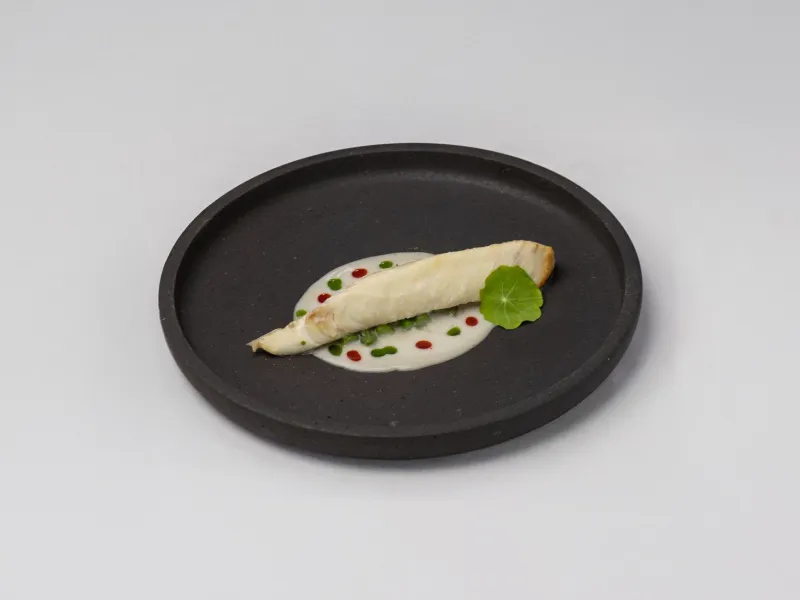
There is a moment, familiar to anyone who has dined at a certain caliber of American restaurant, when a plate arrives and the instinct is to wonder whether something has been forgotten. A single scallop, seared to amber perfection, rests at the lower third of a wide porcelain field. A smear of celery root purée extends no further than three inches. A scattering of micro-herbs—three leaves, perhaps four—occupies the negative space with the quiet authority of a brushstroke. Nothing else. The expanse of white surrounding these elements is vast, almost confrontational.
This is not an oversight. It is, in the language of America's most intellectually rigorous kitchens, a sentence carefully constructed.
A Philosophy Borrowed from Other Arts
The concept of negative space—the deliberate use of emptiness to define and elevate the elements that occupy a composition—has long governed the visual arts, architecture, and design. In Japanese aesthetics, the principle of ma (間) describes the meaningful pause, the productive void, the interval that gives surrounding form its resonance. In modernist painting, from the spare canvases of Mark Rothko to the geometric austerities of Ellsworth Kelly, the absence of content became content itself.
America's most cerebral chefs have absorbed these lessons and transposed them onto the plate. The result is a plating philosophy that treats the dish not as a vessel to be filled but as a stage to be inhabited—selectively, purposefully, with an almost theatrical awareness of proportion and negative space.
At restaurants operating at the highest register of American fine dining, this approach has become something approaching doctrine. Chefs who have trained in the rigorous traditions of French haute cuisine, Japanese kaiseki, or the modernist laboratories of Spain have returned with a shared conviction: that abundance, as an aesthetic principle, is frequently the enemy of meaning.
Restraint as Rhetoric
To understand why restraint communicates so powerfully, it helps to consider what its absence communicates. A plate crowded with components—proteins, starches, sauces, garnishes, microgreens, edible flowers, dots of reduction—announces ambition, certainly, but it also announces anxiety. It asks the diner to admire the effort rather than inhabit the experience. It fills the silence before any question can be asked.
By contrast, a plate that withholds invites. It creates what might be described as a culinary parenthesis: a space in which the diner's attention is not managed but summoned. The eye travels to the single element. The mind engages with it. The first bite arrives not as one sensation among many but as a singular event.
This is the grammar of restraint—the understanding that punctuation and pause are not decorative additions to a sentence but structural necessities. A chef who plates with genuine discipline is not simply arranging food; they are composing a directed experience of perception.
The parallel to literary minimalism is instructive. The spare prose of writers like Joan Didion or early Cormac McCarthy does not feel thin—it feels precise. Every word that remains has survived the elimination of ten others. The same logic, applied to a plate, produces food that feels inevitable rather than assembled.
Portion as Statement
The question of portion size is, in American dining culture, a particularly charged one. The country's culinary history has long equated generosity with value, abundance with hospitality. The oversized entrée, the bottomless bread basket, the dessert large enough to share—these have functioned as cultural signals of welcome and worth.
America's most exacting tasting-menu restaurants have, quietly and deliberately, dismantled this equation. In the multi-course format that now defines the summit of American fine dining, portions are calibrated not to satisfy appetite in the conventional sense but to sustain engagement across a long arc of eating. A course might consist of two bites. A dessert might weigh no more than an ounce. The diner leaves not full in the traditional sense, but satisfied in a more refined one—having experienced a succession of precise, complete moments rather than a single overwhelming event.
This recalibration requires a certain trust between kitchen and guest. The chef is, in effect, asking the diner to surrender the familiar metrics of value—size, weight, volume—and accept a different currency: intensity, precision, intention. At the country's most decorated establishments, that contract is increasingly understood and honored.
The Influence of Japanese Discipline
No influence on contemporary American fine dining plating is more pervasive, or more frequently acknowledged by the chefs themselves, than that of Japanese culinary culture. The kaiseki tradition, in particular, offers a fully realized aesthetic system in which every element of a dish—its placement, its proportion, its relationship to the vessel, the season, and the meal's larger arc—is governed by principles that have been refined over centuries.
Japanese ceramics, with their deliberate asymmetries and irregular glazes, do not simply hold food; they frame it. A piece of grilled fish placed slightly off-center on a rectangular plate is not carelessly positioned—it is positioned to create a more dynamic visual tension, to suggest movement, to leave room for the eye to rest. American chefs who have traveled to Japan, or who have trained under Japanese masters, have returned with this sensibility embedded in their aesthetic instincts.
The influence extends beyond visual composition to the philosophy of sufficiency itself. In kaiseki, each course is understood to be complete in itself—not a prelude to something more substantial, but a self-contained expression of a single idea, ingredient, or seasonal moment. This is a profoundly different relationship with food than the one most Americans grow up with, and its assimilation into the finest American kitchens has produced a measurable shift in how dishes are conceived and experienced.
The Diner's Responsibility
There is, of course, an implicit demand in this mode of dining. A plate composed around negative space asks more of its audience than a plate composed around abundance. It requires the diner to slow down, to look carefully, to resist the impulse toward the next bite before the current one has been fully considered. It presupposes a certain kind of attention—cultivated, patient, willing to be guided.
This is not a universal expectation, nor should it be. But at the level of American fine dining where these principles are most rigorously applied—the twelve-seat counter, the prix-fixe-only dining room, the kitchen that accepts reservations months in advance—the audience has, in some sense, already demonstrated its willingness to enter that contract. The empty plate is not a provocation; it is an invitation extended to those who understand what it is offering.
Apicius himself, that most legendary of Roman gourmands, understood that the most sophisticated pleasures are rarely the most obvious ones. The cooks he celebrated were not those who piled abundance upon abundance, but those who transformed the finest materials through intelligence and discipline. The grammar of restraint, as practiced in America's finest restaurants today, is a continuation of that ancient understanding: that the highest expression of culinary art is not what is added, but what is known to be unnecessary—and left, with great deliberateness, aside.