Glutamates, Nucleotides, and the Pursuit of Depth: How America's Elite Kitchens Are Unlocking the Fifth Taste
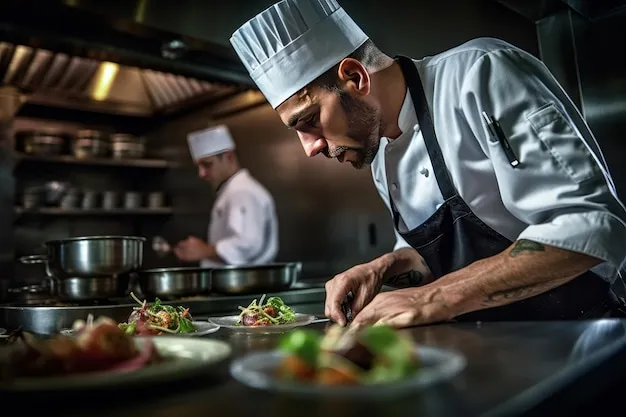
Photo: chef preparing umami rich ingredients kombu mushrooms aged cheese fine dining kitchen, via img.freepik.com
For much of Western culinary history, the vocabulary of taste was confined to four dimensions: sweet, sour, salty, and bitter. The French classical tradition, which long served as the lingua franca of fine dining, organized its sauces, reductions, and compositions around these four pillars with near-mathematical precision. Yet something was always present — ineffable, persistent, deeply satisfying — that resisted categorization. It was the haunting resonance in a long-simmered consommé, the lingering richness of a dry-aged côte de bœuf, the almost meditative depth of a properly aged Comté. That sensation now has a name, a mechanism, and increasingly, a science: umami.
Derived from the Japanese words for "delicious" (umai) and "taste" (mi), umami was formally identified by chemist Kikunae Ikeda at the University of Tokyo in 1908. His isolation of glutamic acid from kombu seaweed gave the sensation a molecular identity. Yet it took nearly a century for Western gastronomy to embrace the concept with anything approaching intellectual seriousness. Today, at the highest echelons of American fine dining, that reticence has given way to genuine fascination.
The Neuroscience Behind the Sensation
Understanding umami begins not in the kitchen but in the laboratory. Glutamates — salts of glutamic acid — bind to specific receptors on the human tongue, designated mGluR4 and T1R1/T1R3. When these receptors are activated, they trigger a cascade of neural signals that the brain interprets not merely as a flavor, but as a signal of nutritional density. Evolutionarily speaking, umami is the body's shorthand for protein: where there is glutamate, there is typically amino acid-rich sustenance.
Nucleotides, particularly inosinate (IMP) and guanylate (GMP), operate in elegant synergy with glutamates. When combined, their effect is not merely additive but synergistic — a phenomenon food scientists call "taste potentiation." A small quantity of IMP alongside glutamate can amplify perceived umami intensity by a factor of eight or more. This biochemical interplay is precisely what makes a slow-cooked dashi — combining glutamate-rich kombu with IMP-laden katsuobushi — one of the most neurologically compelling broths ever devised.
For the American chef trained in classical European technique, this science offers not a disruption but an illumination. It explains why a veal stock fortified with mushroom trimmings tastes more complete than either ingredient alone. It clarifies the instinctive appeal of anchovy in a Worcestershire-glazed preparation, or the transformative effect of a parmesan rind dissolved into a braising liquid.
The American Kitchen as Laboratory
At the forefront of umami-conscious American gastronomy, a generation of chefs is approaching flavor construction with something resembling scientific methodology. In kitchens from New York's West Village to the Napa Valley, culinary teams are cataloguing ingredient combinations not by tradition alone, but by measured glutamate concentration and receptor interaction.
Fermentation programs, once the province of avant-garde tasting menus, have become central to this inquiry. Long fermentation dramatically increases free glutamate content — a fact well understood in the production of soy sauce, miso, and aged cheeses, but now being applied to novel American ingredients. Domestic producers are fermenting everything from locally harvested mushrooms to heritage-breed pork in controlled environments designed to maximize savory depth. The resulting condiments and pastes are finding their way into the mise en place of restaurants that would never have considered fermented preparations a decade ago.
Aged proteins, too, are receiving renewed scrutiny. Dry-aged beef undergoes enzymatic breakdown that liberates free glutamates from bound proteins, intensifying flavor in a manner now understood to be biochemically precise rather than merely experiential. Several American steakhouses and tasting-menu restaurants have extended their aging programs well beyond conventional timelines — some to 90 days or beyond — guided by an understanding of the glutamate curve as much as by tradition or intuition.
Umami as a Design Principle
Perhaps the most significant shift is conceptual. Umami is no longer treated as a happy accident or a background note — it is being deployed as a structural element of dish composition, much as acid or salt might be used to balance or elevate a preparation.
This architectural approach manifests in layering: the deliberate stacking of multiple umami-rich ingredients whose combined effect exceeds what any single component could achieve. A composed dish might begin with a tomato water consommé (rich in glutamate), introduce a garnish of shaved bottarga (high in IMP), and finish with a dusting of dried shiitake powder (abundant in GMP). Each element is chosen not merely for its individual flavor contribution but for its role in a cumulative sensory argument.
The implications for wine pairing are equally significant. Sommeliers at several prominent American restaurants are now consulting umami profiles alongside acidity and tannin when constructing pairings. Certain high-glutamate dishes can render tannic reds astringent and bitter — a phenomenon that experienced sommeliers have long navigated by instinct but are now addressing with greater analytical confidence.
The Connoisseur's New Literacy
For the engaged diner, fluency in umami represents a meaningful expansion of gastronomic vocabulary. To recognize the synergistic interplay of ingredients, to appreciate why a dish achieves its particular resonance, is to participate more fully in the conversation that the finest kitchens are conducting. It transforms the act of dining from passive consumption into active interpretation.
The Roman epicure for whom this publication is named understood, in his own era, that the pursuit of flavor was inseparable from the pursuit of knowledge. Apicius documented not merely recipes but philosophies of taste — an attempt to understand why certain combinations satisfied in ways that others could not. The science of umami is, in many respects, the contemporary continuation of that ancient inquiry: a rigorous, disciplined effort to understand what makes a meal not merely pleasant, but profound.
As American gastronomy matures, its most distinguished practitioners are demonstrating that technical mastery and intellectual curiosity need not be separate endeavors. The kitchen, at its finest, is always also a laboratory — and the table, an invitation to discovery.