Servants of the Flame: How America's Most Disciplined Chefs Are Submitting to the Ancient Authority of Live-Fire Cooking
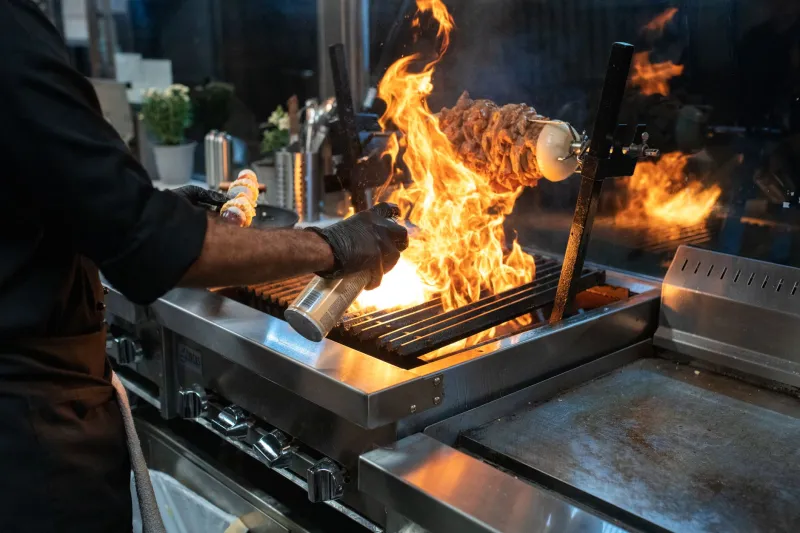
There is a particular moment, familiar to any cook who has worked seriously with live fire, when the flame ceases to feel like an instrument and begins to feel like an interlocutor. The heat shifts. The wood speaks in pops and sighs. A cut of meat, suspended above the coals, begins to respond in ways that no algorithm can fully anticipate. It is, in the most precise sense, a conversation — and America's most exacting chefs are increasingly choosing to engage it.
In an era defined by induction burners calibrated to the degree, sous vide baths held at fractions of a Celsius, and kitchens that resemble laboratories more than hearths, the resurgence of open-flame cookery at the highest levels of American fine dining represents something genuinely remarkable. It is not nostalgia. It is not theater, though theater may attend it. It is, rather, a philosophical reckoning with the nature of mastery itself.
The Limits of Precision
The modernist movement that swept through American haute cuisine in the early decades of this century delivered extraordinary gifts: consistency, control, the capacity to reproduce a dish with scientific exactitude across hundreds of covers. Yet for a generation of chefs trained in this tradition, something began to feel absent — a quality of aliveness, of contingency, that no immersion circulator could replicate.
Chef Camille Fournier, whose wood-fire-centered tasting menu in the Hudson Valley has attracted sustained critical attention, articulates the tension with characteristic directness: "Precision gave us the ability to execute perfectly every time. What it couldn't give us was surprise — the kind of surprise that forces you to be present, to read, to respond. Fire gave that back."
This is the central paradox that animates the live-fire renaissance: the chefs most drawn to the flame are not those fleeing discipline, but those who have mastered conventional discipline so thoroughly that they hunger for a more demanding teacher. The wood-burning hearth, in this context, is not a step backward from refinement. It is refinement's next examination.
A Grammar Older Than Cuisine
To speak of fire as possessing a grammar is not mere metaphor. Those who work with it seriously insist upon the point with some urgency. Different woods yield distinct aromatic vocabularies: white oak offers a long, clean burn with subtle tannin; applewood contributes a sweetness that flatters pork and poultry; hickory asserts itself with a smokiness that demands ingredients of equivalent character. The positioning of the grate, the age and moisture content of the fuel, the season's effect on airflow — each variable constitutes a kind of syntax that the skilled cook must learn to read and compose.
At Brasa, the acclaimed Minneapolis restaurant where chef Jorge Guzmán has long championed live-fire technique, the kitchen maintains what amounts to a library of hardwoods, each selected for its relationship to specific preparations. "You don't use fire," Guzmán has observed. "You negotiate with it. And the negotiation is different every night."
This negotiation extends beyond wood selection into the realm of pure sensory attunement. The accomplished live-fire cook develops what might be described as a secondary perceptual vocabulary: reading the color of a coal bed not merely as a visual phenomenon but as a thermal text, interpreting the sound of fat meeting flame as information about temperature and timing, gauging the aromatic evolution of a cooking protein as a real-time index of its interior state. These are competencies that cannot be acquired from a manual.
The Intelligence of Intuition
Among the more provocative arguments advanced by live-fire's most committed practitioners is the suggestion that the technique demands — and ultimately cultivates — a form of intelligence distinct from the analytical cognition prized in modernist kitchens. Call it somatic intelligence, or culinary intuition: the capacity to synthesize streams of sensory data into immediate, accurate judgment without the mediation of conscious deliberation.
Chef Francis Mallmann, the Argentine luminary whose influence on American open-fire cooking is difficult to overstate, has spoken of the flame as a force that strips away the cook's defenses, demanding a quality of presence that other techniques do not require. Several American chefs who have staged in his kitchens describe a similar experience: an initial period of anxiety as familiar controls are removed, followed by a gradual recalibration of attention — a learning to see, hear, and smell with new acuity.
At Bruto in Washington, D.C., chef Chris Morgan has built a program around this principle of heightened presence. His kitchen team undergoes extended periods of working exclusively with live fire before any dish is considered for the menu, a practice Morgan describes as "earning the right to cook this way." The resulting preparations — a whole turbot suspended over vine cuttings, heritage pork collar rested directly on hardwood coals — carry what regular guests describe as an ineffable quality of immediacy, a sense that the food has been coaxed into existence rather than manufactured.
Refinement, Not Primitivism
It bears emphasis that the finest expressions of live-fire cooking in contemporary American fine dining are distinguished from their casual counterparts by an almost obsessive attention to detail that would be recognizable to any student of classical technique. The sourcing of animals and produce is, if anything, more rigorous: fire, which amplifies and concentrates, is unforgiving of mediocrity in the primary ingredient. The mise en place is more elaborate, not less, because the cook cannot rely on adjustable heat to compensate for imperfect preparation.
Serviceware, too, rises to meet the occasion. At several restaurants where live-fire cookery anchors the menu, sommeliers have developed wine programs specifically calibrated to the aromatic registers that wood smoke introduces into food — a task requiring considerable knowledge of how smoke interacts with the tannin structures of red wines and the acidity of whites. The table, in these establishments, becomes a unified sensory argument in which fire is not a novelty but a foundational voice.
A Return to First Principles
Apicius, the legendary Roman gastronome who lends his name to this publication, would perhaps have found the current conversation somewhat puzzling. For him, and for the many centuries of cooks who followed, fire was not a philosophical choice but the simple condition of cooking. The act of submitting to its demands required no manifesto.
And yet there is something clarifying in the distance we have traveled. Having built and then partially dismantled an architecture of technological control, America's most thoughtful chefs are discovering in live fire not a rejection of everything they have learned, but a deeper application of it. The flame does not forgive inattention. It does not reward complacency. It asks, with absolute consistency, for the cook's full presence and accumulated knowledge.
In this sense, the live-fire renaissance is less a return to origins than an arrival at a more demanding understanding of what culinary mastery truly requires. The most sophisticated kitchens in America are learning, again, to listen to the fire — and finding that it has always had a great deal to say.