The Sovereignty of Less: Why America's Most Disciplined Chefs Are Treating Subtraction as the Highest Culinary Art
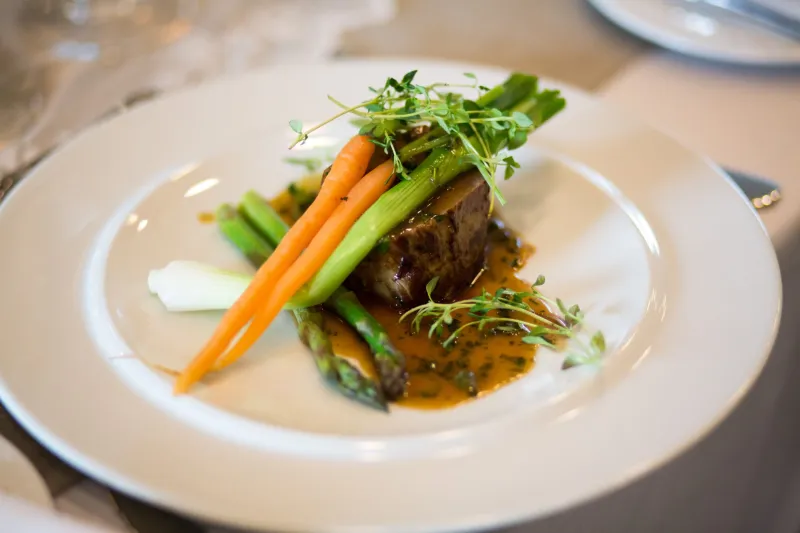
There is a particular courage required to place before a guest a single, immaculate scallop — nothing more. No emulsion pooled beneath it, no microherb constellation arranged above, no architectural fragment of dehydrated something-or-other leaning against its flank. Just the scallop, seared to a copper crust on one face, its interior still trembling with the cold memory of the sea. The courage is not theatrical. It is philosophical. And in America's most rarefied dining rooms, it is increasingly regarded as the truest measure of a chef's command.
For much of the past two decades, the dominant visual grammar of fine dining in the United States has been one of accumulation. The tasting menu as cabinet of curiosities. The plate as manifesto. Chefs trained in the idiom of maximalism learned to read a dish's ambition in its density — in the number of components, the layering of techniques, the audacity of juxtaposition. And there is, to be certain, a breathtaking intelligence in that tradition. But a counter-philosophy has been gathering force in kitchens from Manhattan's West Village to the coastal corridors of California, one that regards the impulse to add as, ultimately, a failure of nerve.
The Discipline of Deliberate Exclusion
Chef Elara Voss, whose intimate twelve-seat restaurant in Portland, Oregon has become something of a pilgrimage site for the culinarily devout, describes her creative process in terms that sound more architectural than culinary. "Every dish begins with excess," she explains. "I build it fully — every element I can conceive of that belongs — and then I begin to dismantle. What I'm looking for is the point at which removing one more thing would cause the whole to collapse. That threshold is where the dish actually lives."
This is not minimalism for its own sake, nor is it the studied austerity of a chef performing asceticism for a sophisticated audience. It is, rather, a form of structural engineering — the recognition that every ingredient on a plate carries not just flavor but argument, and that too many arguments produce not richness but noise. The single-ingredient dish, in this framework, is not a limitation. It is the equivalent of a perfectly constructed sentence: every word load-bearing, nothing decorative, the meaning undiluted.
The philosophical lineage is not difficult to trace. Apicius himself — that great Roman epicure whose name has become synonymous with the pursuit of culinary truth — understood that the most profound pleasures are those that arrive without distraction. The finest garum was not the most complex; it was the most concentrated, the most purely itself. Contemporary minimalism in the American kitchen is, in some sense, a return to that ancient understanding: that intensity and multiplicity are not the same thing.
Against the Tyranny of the Composed Plate
The maximalist tradition is not without its defenders, and they make their case with eloquence. Chef Marcus Delacroix, whose New York tasting menu is celebrated for its baroque intricacy — a single course might involve seven distinct preparations of a single protein — argues that restraint can become its own kind of orthodoxy. "There is a certain smugness that can creep into minimalism," he observes with careful diplomacy. "The idea that the chef who shows you less is somehow more serious than the chef who shows you more. But Escoffier didn't build the architecture of French cuisine by leaving things out. He built it by understanding how things belong together."
This tension — between the chef as editor and the chef as composer — defines one of the most generative debates in contemporary American fine dining. And the most intellectually honest practitioners on both sides will acknowledge that the divide is not simply aesthetic. It is ethical. It concerns what a chef believes the act of eating is fundamentally for: whether the dining table is a place of revelation or of abundance, whether the guest's role is to receive or to be overwhelmed.
Negative Space as Culinary Instrument
Perhaps the most radical expression of the minimalist doctrine is the use of negative space on the plate — not merely the absence of excess garnish, but the deliberate deployment of emptiness as a compositional element. At a celebrated tasting room in San Francisco's Hayes Valley, a course of house-aged butter arrives on a stone slab of considerable dimension, the butter placed not at center but near one edge, the remainder of the surface left entirely bare. The effect is, at first encounter, almost confrontational. And then, gradually, clarifying. The eye has nowhere else to go. The butter — its color, its texture, the faint impression left by the mold — becomes the only subject in the room.
This is plating as phenomenology. The chef is not merely arranging food; she is arranging attention. And attention, in an age of relentless sensory competition, has become perhaps the most valuable thing a restaurant can offer its guests.
Chef Dominic Harlow, whose residency in Chicago's Fulton Market district has attracted considerable critical notice, frames the practice in terms borrowed from music. "Silence in a composition is not the absence of music," he says. "It is music. The rest gives meaning to the notes around it. When I leave space on a plate, I'm not failing to fill it. I'm using it. The guest's eye — and then their mind — travels that space, and the arrival at the food is different for having made that journey."
The Rigor Behind the Apparent Ease
What the most sophisticated advocates of culinary restraint are at pains to emphasize is the extraordinary technical demand that simplicity imposes. The maximalist plate, for all its complexity, offers the cook a form of concealment. A brilliant sauce can rescue an imperfect sear. A scattering of precisely cut herbs can redirect attention from a protein that is marginally overdone. The minimalist dish offers no such mercy. When a plate contains a single element, that element must be, in every particular, beyond reproach.
"Simplicity is the most unforgiving discipline I know," says Voss. "When there is nothing else on the plate, the ingredient has to speak for itself. Which means you have to understand that ingredient at a level that most people never bother to reach. You have to know its ideal temperature, its ideal texture, the precise moment in its life — literally, in the case of something living — when it is most itself. That knowledge is not simple. The presentation is simple. The knowledge behind it is immense."
This is, perhaps, the central argument for restraint as sophistication: that it demands more of the cook, not less. The chef who reduces a dish to its essential element is not choosing the easy path. She is choosing the one that offers no cover, no distraction, no sleight of hand. She is placing her full command before the guest and saying, simply: look.
What Remains
The finest restaurants in America — regardless of where they fall on the spectrum between maximalism and minimalism — share a commitment to intention. The question that separates the merely accomplished from the genuinely visionary is not how much appears on the plate, but how completely the chef understands why each element is there. Restraint, at its most rigorous, is not an aesthetic preference. It is an epistemological stance: a declaration that the chef knows, with certainty, what belongs and what does not, and has the confidence to act on that knowledge absolutely.
In that sense, the empty space on the stone slab in Hayes Valley and the seven preparations of duck in the West Village are not opposites. They are different answers to the same question — what does this dish need to be fully itself? — and the quality of that answer is the measure of the chef's art.
Apicius, one suspects, would have understood both impulses. He would also have known, with the unerring instinct of the truly cultivated, when to stop.